West Chester Harley-Davidson® - Which Rider Safety Enhancements on the 2026 Harley-Davidson® Low Rider® S add the most confidence around Smyrna, DE?
Riding confidence starts with a motorcycle that feels composed when the road throws a curve—literal or otherwise—and the 2026 Harley-Davidson® Low Rider® S delivers that assurance with a thoughtful suite of Rider Safety Enhancements + Ride Modes. Around Smyrna, DE, where routes can shift from smooth highway to shaded backroad in a single mile, systems that help the bike manage traction, braking, and downshifts can make a tangible difference in how relaxed and consistent you feel on the bars.
This guide breaks down how each technology contributes on real roads, why it matters for riders stepping up to more power, and how to set the bike up so the electronics complement your inputs rather than override them. We will also cover practical tips for leveraging ride modes day to day and pairing those settings with tire care and suspension basics for a more predictable, enjoyable ride.
Cornering awareness is the game-changer
Cornering Rider Safety Enhancements are designed to adapt as lean angle changes. In a straight line, anti-lock braking and traction control are straightforward. Add a lean angle, and the physics change—the contact patch narrows, and the threshold for slip drops. Cornering Enhanced Anti-lock Brake System (C-ABS) helps moderate brake pressure at these angles, while Cornering Enhanced Traction Control System (C-TCS) aims to limit excessive rear-wheel spin mid-corner and on corner exit. On sweeping connectors or off-camber turns near woodland stretches south of town, this helps the bike stay planted without abrupt intrusions.
Matched with Michelin® Scorcher 31 tires, split 7-spoke floating rotors, and the Low Rider® S geometry, those cornering-aware systems become part of an integrated handling package. You still set your line and choose your inputs—the technology simply provides support when grip is less than ideal.
Downshifts and deceleration—smooth equals stable
Two more pieces of the puzzle work during engine braking events. Drag-Torque Slip Control System (DSCS) is designed to reduce excessive rear-wheel slip triggered by abrupt downshifts or rapid throttle closure. Cornering Drag-Torque Slip Control System (C-DSCS) takes that logic and adapts it when the bike is leaned over. If you are setting up for a tight right-hander off US-13 and need a decisive downshift, DSCS and C-DSCS help keep the chassis calm so you can focus on turn-in instead of managing an unsettled rear.
For riders who like to brake late and carry steady throttle into the apex, that stability encourages smoother, more repeatable lines. It is not a substitute for technique, but it is a supportive buffer when conditions vary—especially valuable on unfamiliar or patchy pavement.
Ride modes—tailor the throttle to the day
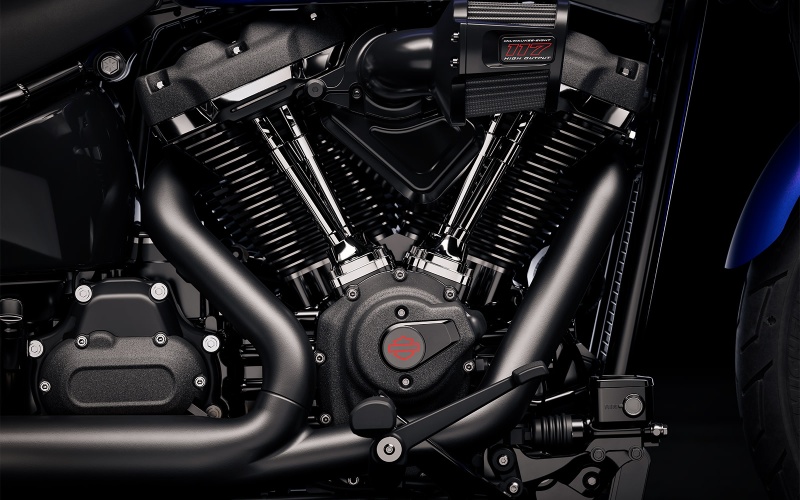
Ride modes on the 2026 Harley-Davidson® Low Rider® S tune throttle response and intervention thresholds, giving the motorcycle a different character at the push of a button. On clear, dry days with warm pavement, a more assertive map unlocks the Milwaukee-Eight® 117 High Output motor’s crisp response. When temperatures dip or you encounter damp stretches along rural farm roads, a more measured map softens that initial hit, making fine throttle control easier at low speeds and mid-corner.
The key is to treat ride modes as you would suspension settings—match them to conditions. A brief pre-ride check of the road surface and weather can guide your choice, and you can change modes when conditions evolve. This simple habit aligns power delivery with grip so the chassis feels predictable.
Practical setup tips for local rides
Electronics perform best when the fundamentals are dialed. Keeping your tires at proper pressures and ensuring your suspension preload suits your weight and gear load sets a strong baseline. Within that framework, you can fine-tune electronics for Smyrna, DE’s mix of main routes, neighborhood streets, and rural cut-throughs.
- TPMS Vigilance: Use the Tire Pressure Monitoring System to verify pressures before you roll; small deviations can change feel and increase intervention.
- Mode Matching: Choose a ride mode based on the day’s conditions—dry and warm, cool and damp, or mixed surfaces on DE-1 and local connectors.
- Brake Smoothness: Apply progressive front brake pressure and keep the bike neutral into the corner; let C-ABS assist rather than trigger abrupt inputs.
- Throttle Discipline: Feed power in as the bike stands up; C-TCS can help when grip is marginal, but smooth wrists equal smoother exits.
- Downshift Timing: Downshift early and decisively; DSCS and C-DSCS help, but clean rev-matching keeps the chassis settled.
These habits make the rider aids feel nearly invisible—present when needed, unnoticeable when not. The result is consistency, which builds confidence ride after ride.
How this complements the chassis and power
The Low Rider® S backs up its electronics with hardware tuned for spirited riding. A 43 mm inverted front fork, hidden coil-over monoshock with hydraulic preload adjustment, and taller rear shocks deliver both agility and stability. The 31.3-degree lean angles left and right, combined with Michelin® Scorcher 31 tires, support real cornering capability, while 4-piston fixed front and 2-piston floating rear calipers on split 7-spoke floating rotors provide authoritative braking. Tie that to the Milwaukee-Eight® 117 High Output motor’s 114 HP and 128 ft-lbs of torque, and you have a platform that invites precision—and rewards it.
On Smyrna, DE’s daily routes—whether cruising DE-6 to the lake or navigating stop-and-go on Walnut Street—the ability to adapt throttle character and traction thresholds extends the bike’s comfort zone without dulling its edge.
Where we fit into your journey
West Chester Harley-Davidson® can help you get the most out of these systems with personalized setup guidance and practical coaching on how to pair ride modes with your favorite routes. Our team is experienced in configuring the Low Rider® S for riders who want a locked-in posture, clear feedback, and technology that supports refined control without getting in the way.
If you are exploring a performance-focused cruiser and want it to feel natural on Smyrna, DE’s mix of roads, the combination of Rider Safety Enhancements + Ride Modes, a confidence-inspiring chassis, and a torque-rich powertrain checks every box. For regional riders serving King of Prussia, PA, Phoenixville, PA, and Smyrna, DE, that balance of control and character is exactly why this model resonates.
Frequently Asked Questions:
Do Rider Safety Enhancements reduce performance on dry, high-grip days?
No. With an appropriate ride mode selected, the systems are calibrated to stay in the background. Smooth, consistent inputs on warm, clean pavement rarely trigger interventions; if they do, it is typically subtle.
Can ride modes be changed on the fly?
Yes, the system is designed so you can change modes to match conditions. Always make mode changes when it is safe to do so and verify your selection on the display before rolling on.
Will TPMS tell me exactly what pressure to run?
TPMS alerts you to low or high pressure and displays current readings, helping you maintain the recommended range. It complements, not replaces, periodic checks with a trusted gauge.
Are these systems a substitute for rider training?
They are not. Consider them a safety net. Good technique—smooth braking, accurate downshifts, and progressive throttle—lets the technology support your skill, not mask it.